
Why management-company leadership should advise boards to adopt financial disclosure and why homeowners should see it on the documents they actually receive
By Bill McKay, Founder & CEO, HOA Doctor®
Author disclosure: HOA Doctor offers HOA CLEAR™. This article advocates a disclosure standard that boards can request whether or not they purchase HOA CLEAR services.
Your management fee may not explain every financial relationship connected to your community. Payments, benefits, and ownership ties outside that fee may be relevant to the recommendations your board receives. Homeowners should be able to understand those arrangements.
Watching the University of Michigan play Indiana, I saw a Fisher Investments advertisement and something clicked. People expect the professionals entrusted with their money to explain how they get paid. HOA homeowners deserve that clarity, too.
Fisher publicly identifies itself as a fiduciary investment adviser, explains its management fee structure, and describes how third-party custodians hold client assets. Its fiduciary duty is more than a marketing slogan: investment advisers operate under a legal framework that addresses client interests and conflicts.
The SEC explains that advisers must address conflicts through elimination or sufficiently specific, full and fair disclosure permitting informed consent. Disclosure alone does not replace the obligation to act in the client’s best interest.
HOA management companies perform different services under different legal rules. Their duties depend on applicable law, contracts, and the relationship involved. The association is ordinarily the contracting client; homeowners fund it. This comparison is a call for understandable financial disclosure, not an assertion that every PMC owes the same duties as an investment adviser.
Management companies should lead. Boards should insist.
The company receiving compensation is best positioned to explain it. Management-company owners and executives should proactively advise their client boards to adopt a written disclosure policy and supply the information necessary to implement it.
The question is broader than whether the management fee is disclosed: Does your management company explain all compensation and financial relationships connected to your community? That includes banking-related benefits, vendor and insurance referral arrangements, ownership ties, and fees collected from individual homeowners.
Our proposed standard has three parts: disclose the relationships, evaluate them at board level, and deliver an understandable explanation to homeowners. Boards can incorporate these expectations into their management arrangements. Direct homeowner delivery is the policy advocated here, not a claim of a universal existing legal requirement.
Disclosure is the starting point. A board should evaluate the arrangement, ask whether alternatives offer better value, and address any conflicts. Neither a signed disclosure nor participation in HOA CLEAR™ establishes that an arrangement is lawful, reasonable, or in the association’s best interest.
CAMs should have clear answers from their employers. They should not be left defending financial arrangements they did not design and cannot explain.
Give HOA invoices an ingredients label
A familiar ingredients label helps a shopper understand what is inside a product. An HOA financial label could serve a similar purpose: show the financial components of a charge and any relevant relationship behind it.
This is a proposed disclosure format, not a claim that food-label rules apply to HOA management.
Boards should insist that every PMC invoice carry a standardized financial-disclosure panel. The panel should explain that invoice’s charges and link to a signed, dated community-specific disclosure covering broader arrangements. Benefits unrelated to a particular invoice should be reported separately, rather than misleadingly allocated to it.
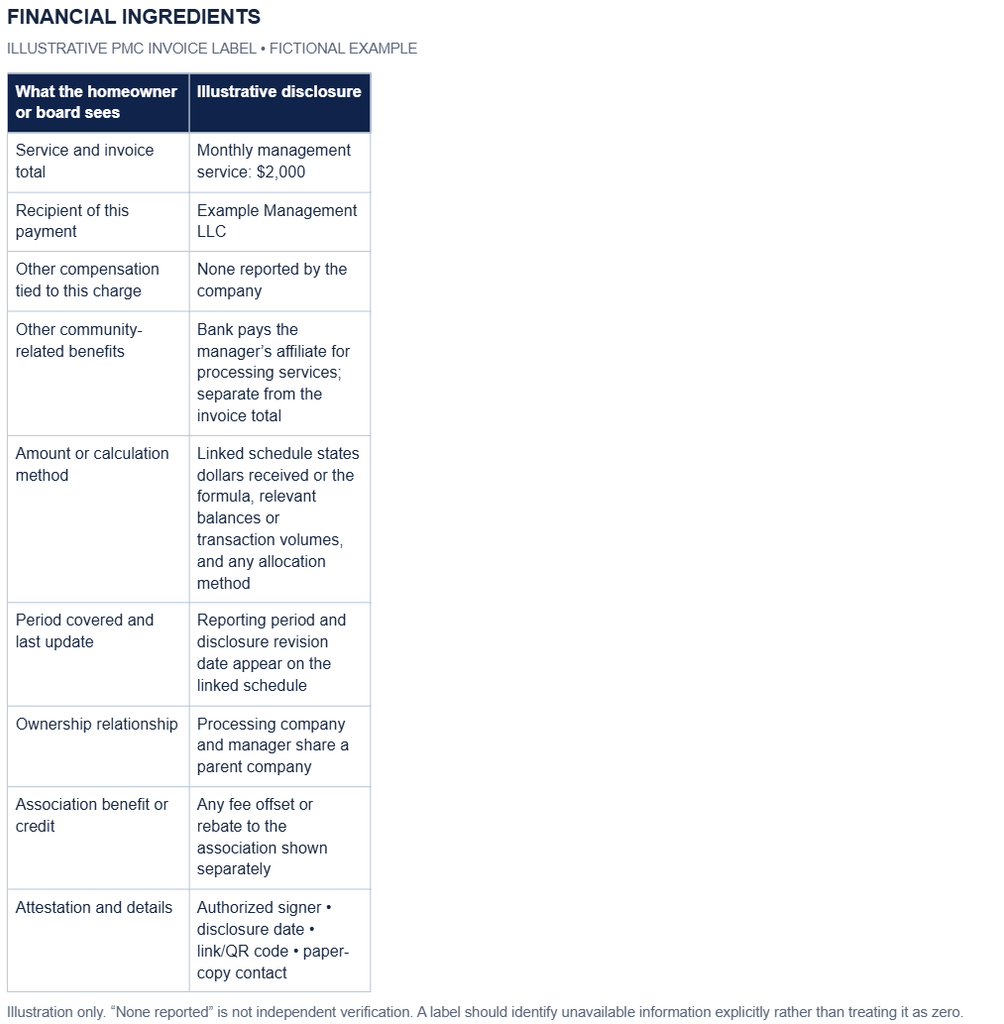
Where payments cover several communities, the disclosure should explain any reasonable allocation method and its limits. If no community-level amount can be determined, say so explicitly, provide the available formula or aggregate information, and explain what remains unknown. Merely acknowledging that a relationship exists may leave its financial significance unclear.
The homeowner’s assessment statement is a different document from the management company’s invoice. It should carry its own prominent notice: “Management-company financial relationships: view the signed disclosure here, or request a paper copy.”
Deliver the full disclosure when adopted and when materially updated. Keep it accessible with every statement. Do not expose account numbers or other sensitive banking information.
Riva is continuing in California, but precision matters
In Riva on the River Homeowners Association v. The Management Association, Inc., doing business as The Management Trust, a California federal court is examining a dispute involving bank-related “earnings credits.” Riva alleges undisclosed payments linked to association deposits. TMT disputes that characterization and describes payments for banking services. The August order also records an affiliate-services disclosure offered by TMT.
On August 27, 2026, the court denied class certification and dismissed three claims with leave to amend, including the fiduciary-duty claim. That was not a class-wide victory or a finding that the alleged conduct was unlawful.
There is a concrete later development: an October 8 order extends discovery and sets a jury trial for September 7, 2027. The supporting stipulation describes recently discovered documents, non-party subpoenas, and potential additional discovery associated with amended pleadings.
That supports saying the litigation continues with further evidence-gathering. It does not establish revived class certification, wrongdoing, or liability for banks or insurers. Trial dates can change.
Ask about both sides of the payment
A useful disclosure follows the entire relationship: who pays, who receives, what service is supplied, how compensation is calculated, and what the association was told.
That means asking banks, insurance carriers, brokers, and other vendors to explain relevant payments to management companies or their affiliates. A legitimate service fee should be described as such, with enough detail to evaluate it. Ordinary insurance commissions should not automatically be labeled kickbacks.
The Riva materials reviewed do not establish that insurers or brokers are defendants, or that any bank has been held liable. Broader questions about payment sources are a policy implication, not a court finding. Any potential claim against a payer would require its own evidence and applicable legal basis; paying money alone does not establish liability.
Put disclosure on the next board agenda
Management-company owners and executives should advise boards to adopt this standard and provide the underlying information. CAMs should have the employer support needed to answer questions accurately.
At your next board meeting, request management’s signed financial-relationship disclosure within 30 days. This is a proposed response deadline, not a statutory one. Ask for missing information to be identified with a completion date.
Then schedule a board review of the disclosed arrangements, document the evaluation and any actions needed, and establish how the explanation will reach homeowners. The invoice panel and assessment-statement notice should become routine communication tools, supported by a current, complete disclosure.
HOA CLEAR™ provides a starting point. Boards can request the same information without purchasing our services. The objective is a disclosure standard homeowners can understand and boards can use.
Explain the financial relationships.
Evaluate them before approving or renewing arrangements.
Deliver the explanation to homeowners.
Sources are linked inline. Case status reflects the orders reviewed through October 24, 2026. This article proposes a disclosure standard; it does not describe a universal existing invoice-label requirement. Fisher Investments is referenced for comparison only; no affiliation or endorsement is implied.
